- med4vl
- May 7, 2022
- 2 min read
ECG Findings Explained
Left bundle branch block can result in several ECG findings, including QRS prolongation, broad R waves in left-sided leads, and QS or rS waves in right-sided leads. When examining the ECG, keep in mind that left bundle branch block can both mimic, conceal, and be caused by myocardial ischemia/infarction.
QRS Prolongation
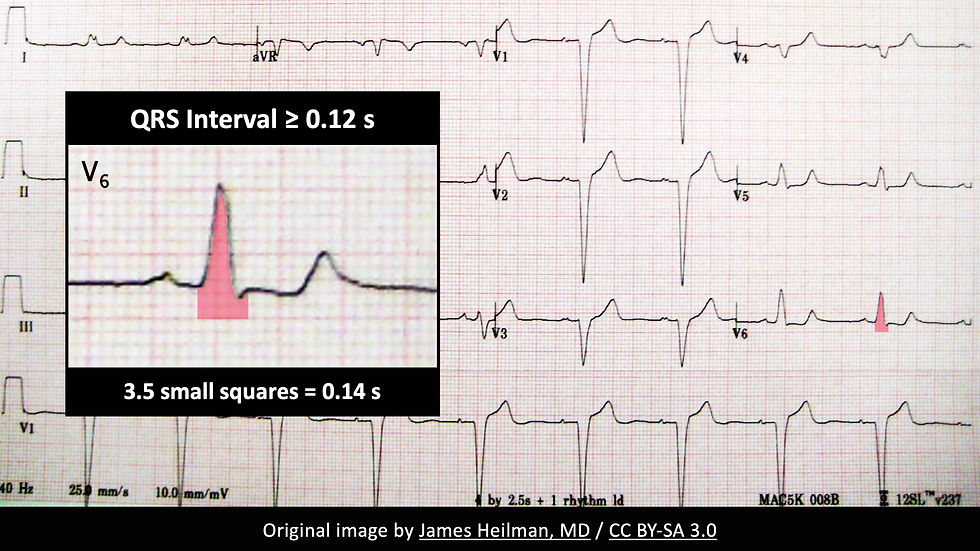
The fundamental electrocardiographic finding of bundle branch block is a wide QRS complex. In adults, complete bundle branch block is present when the QRS complex is 120 milliseconds or greater in duration. On an ECG with a standard paper speed of 25 mm/s, this translates to a QRS complex that is 3 small squares or wider.
Left Lead QRS Morphology (Broad R Waves)
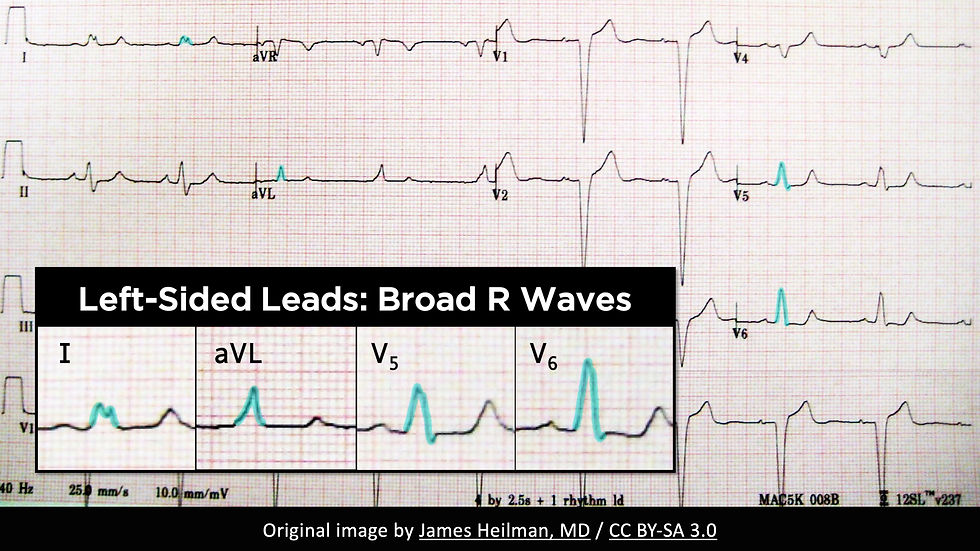
The morphology of QRS complexes can also provide important clues. The QRS complexes in left-sided leads have a large positive deflection (i.e., R wave), which can be monophasic or have a notch. However, if q waves are present in leads I, V5 and V6, then consider the possibility of myocardial ischemia or infarction.
Right Lead QRS Morphology (Large QS/rS Waves)
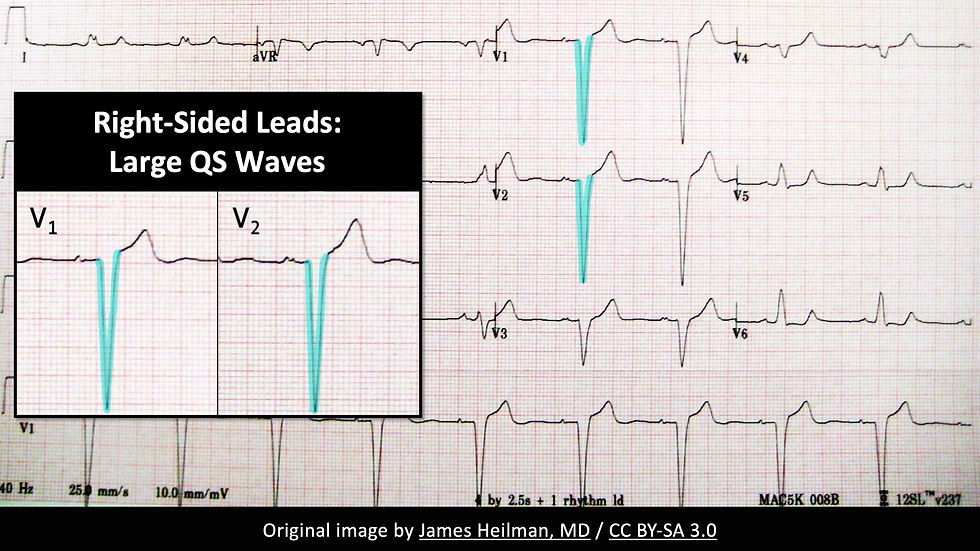
The QRS complexes in right-sided leads consist of a deep and wide negative deflection.
Prolonged Peak R Time in V5 and V6
Another important finding is that of a prolonged Peak R Time in leads V5 and V6. That is, the peak R time in leads V5 and V6 is greater than 60 milliseconds, but normal in leads V1 to V3- in which it may not be discernable due to the lack of r waves.

Discordance
Note that the ST segment and accompanying T waves can be deflected in the opposite direction of the QRS complex. This is referred to as discordance. Essentially, when the QRS complex is positive then the T wave is inverted, and vice-versa.
Left-Axis Deviation
With left bundle branch block, the axis is usually deviated left-ward; however, it may be normal.
Summary
The main ECG findings that occur with left bundle branch block include:
QRS prolongation
Broad R waves in left-sided leads
Large QS or RS waves in right-sided leads
A prolonged peak R time in leads V5 and V6
And remember to always keep in mind that a left bundle branch block can mimic, conceal, and be caused by myocardial ischemia or infarction.
Video Lecture